
I. Introduction
Nothing causes panic like a production backend dropping dead. If you have spent hours debugging a stuck 99% request, you know the struggle. Today, AI music is booming. Yet, devs still lack an official, stable Suno API. Unstable reverse proxies keep breaking. This directly threatens your platform’s retention and revenue.
To save you time, we tested the top ten gateways. We evaluated actual enterprise metrics: uptime under peak loads, latency, SDK quality, and pricing. This direct comparison helps you bypass costly billing traps. Find the exact high-fidelity engine your infrastructure needs to scale smoothly.
Quick Comparison Matrix
| Provider | Core Focus | Billing Model | SLA Rating | Recommendation | Best Use Case |
| ApiPass | Enterprise High-Availability | Pay-as-you-go | 🌟🌟🌟🌟🌟 | 🌟🌟🌟🌟🌟 | Scale scale applications, complex prompts, high concurrency |
| Kie.ai | Low-latency Reverse Proxy | Pay-as-you-go | 🌟🌟🌟🌟 | 🌟🌟🌟🌟 | High-concurrence demand with strict response-time needs |
| PiAPI Portal | Stable Production Proxy | Multi-tier Pay-as-you-go | 🌟🌟🌟🌟🌟 | 🌟🌟🌟🌟🌟 | High-traffic consumer applications on a global scale |
| APIFrame | Lightweight Media Engine | Pay-as-you-go | 🌟🌟🌟🌟 | 🌟🌟🌟🌟 | Quick direct integrations without bloated SDK requirements |
| AIML API | Unified Multi-modal API | Pay-as-you-go / Tiers | 🌟🌟🌟🌟 | 🌟🌟🌟🌟 | Unified multi-modal pipelines (Text + Image + Audio) |
| Apixo | Secure Compliance | Subscription / Custom | 🌟🌟🌟🌟 | 🌟🌟🌟🌟 | Enterprise security setups needing strict prompt filtering |
| PiAPI Suno-v5 | High-Definition Render | Premium Pay-as-you-go | 🌟🌟🌟🌟 | 🌟🌟🌟🌟 | Premium audio applications needing maximum fidelity outputs |
| Evolink AI | Workspace Integrations | Unified Subscriptions | 🌟🌟🌟 | 🌟🌟🌟🌟 | Speedy software prototypes and quick startup MVP landing sites |
| Krater.ai | Creative All-rounder Hub | Tiers / Monthly | 🌟🌟🌟 | 🌟🌟🌟 | Interactive UI prototyping, content creator workflows |
| PiAPI Space | Open Sandbox Platform | Free / Private Hosting | 🌟🌟 | 🌟🌟🌟 | Simple experiments, thesis work and quick functional PoCs |
II. The Top 10 Suno API List
1. ApiPass — High-Availability Enterprise Choice
Overview
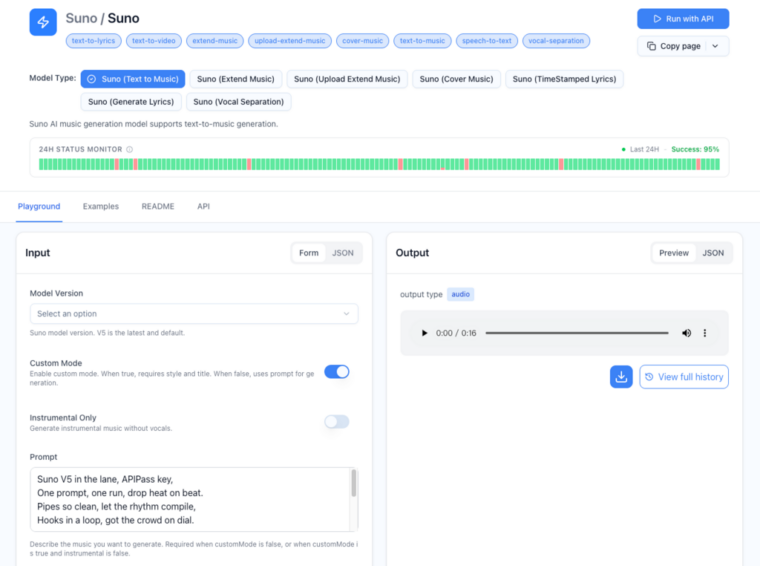
As a premier Suno AI API solution, ApiPass is built specifically for production-grade SaaS products. Designed around a redundant structure, ApiPass acts as an intelligent router that dynamically distributes requests across global, physically isolated account pools, completely bypassing official platform limits and rate blocks.
Key Features
- Advanced Async Webhooks: Instantly sends the generated track’s audio URL, cover image, and metadata as soon as it’s completed on the server side.
- Complete Parameter Support: Full control over song customization, instruments, continue/extension markers, and lyrics generation.
Pros & Cons
- Pros:
- Industry-leading SLA (99.9%) backed by highly intelligent request failover and route balancing.
- Second-level asynchronous webhooks ensure smooth connection handling under high traffic.
- Highly detailed usage dashboard with transparent, itemized invoicing.
- Industry-leading SLA (99.9%) backed by highly intelligent request failover and route balancing.
- Cons:
- No forever-free testing tiers or ad-supported demo credits.
- The setup documentation has a steep technical curve for non-developers.
- No forever-free testing tiers or ad-supported demo credits.
Pricing
- Pay-as-you-go Plan: Starts at a competitive $0.012 per successful song generation (which generates 2 clips).
- Enterprise Tier: High-volume custom contracts are available, driving the cost down to $0.008 per song for over 100,000 monthly generations.
Best For
Commercial B2B SaaS products and medium-to-large consumer apps requiring zero downtime, high concurrent capabilities, and strict SLAs.
2. Kie.ai — Performance-Obsessed Architecture
Overview
Kie.ai Suno API is a highly reliable option for engineering-focused teams. Avoiding excessive marketing, Kie.ai channels its resources into low-level network optimization and proxy rotation, ensuring stable connections even during peak global demand.
Key Features
- Low-Level Protocol Direct Access: Bypasses heavy API gateways to establish faster handshakes and reduce response delays.
- Granular Debugging Logs: Access precise request-response headers straight from the dashboard for fast troubleshooting.
Pros & Cons
- Pros:
- Outstanding stability under high-concurrence peak loads, which is essential for viral applications.
- Incredibly smart automatic retry behaviors managed directly at the protocol layer inside the proxy.
- Outstanding stability under high-concurrence peak loads, which is essential for viral applications.
- Cons:
- The web console interface is highly technical and aesthetic-free.
- Alternative payment methods like PayPal or Crypto are not widely supported.
- The web console interface is highly technical and aesthetic-free.
Pricing
- Flat-Rate Pay-as-you-go: Direct, simple pricing of $0.015 per successful song generation. No monthly financial commitments are required to access premium execution queues.
Best For
Hardcore software engineers and development teams who manage highly demanding workloads and need fine-grained control over API performance.
3. PiAPI Main Portal — Global Production Infrastructure
Overview
The flagship PiAPI Portal is a highly reliable option for enterprise-grade generative AI integrations. By combining Midjourney, Luma, and Suno APIs on a single platform, PiAPI provides robust media-generation capabilities supported by structured account pools and global edge acceleration.
Key Features
- Advanced Anti-Ban Systems: Utilizes proprietary technology to manage high-volume requests smoothly and safely.
- Global Edge Routing: Minimal routing latency achieved through endpoints distributed across strategic cloud data centers.
Pros & Cons
- Pros:
- Highly mature multi-modal architecture with outstanding account pool insulation.
- Advanced regional routing nodes ensure minimal connection latency worldwide.
- Highly mature multi-modal architecture with outstanding account pool insulation.
- Cons:
- High initial financial hurdle with strict deposit minimums to activate active status APIs.
- Complex enterprise capabilities require offline negotiations with the sales unit.
- High initial financial hurdle with strict deposit minimums to activate active status APIs.
Pricing
- Standard Usage Plan: Pay-as-you-go starting at $0.018 per successful song generation.
- Deposit Requirement: Requires a minimum initial account balance deposit of $50 to unlock production API keys.
Best For
Scaled global platforms and high-volume digital agencies that need reliable infrastructure to handle unpredictable usage spikes.
4. APIFrame — Fast & Clean Media Engine
Overview
APIFrame is a streamlined API engine specialized in media-generation APIs. Built with a focus on simplicity, APIFrame strips away unnecessary features to deliver raw, ultra-fast endpoints with zero payload bloat.
Key Features
- Clean JSON Payloads: Simplified response schemas that speed up direct front-end parsing.
- Instant Fail-Safe Refund Logs: Your account is credited automatically inside your dashboard if a generation fails.
Pros & Cons
- Pros:
- Extremely lightweight and fast response payloads with no unnecessary metadata.
- Highly reliable, near-instant automated wallet balance recovery system for any failed generations.
- Extremely lightweight and fast response payloads with no unnecessary metadata.
- Cons:
- Sparse documentation and no native SDK libraries (all endpoints require custom Curl/Fetch methods).
- Lacks enterprise-standard compliance configurations and safety controls.
- Sparse documentation and no native SDK libraries (all endpoints require custom Curl/Fetch methods).
Pricing
- Linear Pay-as-you-go: Flat rate of $0.014 per successful song loop creation. No platform entrance minimums or monthly membership commitments are required.
Best For
Independent developers and indie hackers seeking a clean, fast-to-integrate API with straightforward billing.
5. AIML API — The Ultimate Multi-Modal Gateway
Overview
For projects that go beyond audio, AIML API Suno Gate provides a large, unified developer ecosystem. Rather than offering a standalone audio proxy, AIML API incorporates Suno into their broad collection of hundreds of generative models under a single API key.
Key Features
- One Key for Everything: Call LLMs, text-to-image, video generators, and Suno AI music without changing libraries.
- Excellent Documentation & Playground: Offers a clean web-based API tester that outputs immediate integration scripts in multiple languages.
Pros & Cons
- Pros:
- Extremely low integration overhead for multi-tier applications utilizing multiple AI elements (text, image, music) under one umbrella.
- Full GDPR compliance and enterprise-level encryption on routing servers.
- Extremely low integration overhead for multi-tier applications utilizing multiple AI elements (text, image, music) under one umbrella.
- Cons:
- Single song generation costs are slightly higher than those of direct mono-API specialized proxies.
- Occasional delays of several days in rolling out minor Suno version updates.
- Single song generation costs are slightly higher than those of direct mono-API specialized proxies.
Pricing
- Pay-as-you-go Rate: Billed flat at $0.020 per successful generation.
- Subscription Tier: Developer subscription plans start at 29permonth,whichincludes29p**ermonth,whichinclud**es35 worth of multi-modal generation credits.
Best For
Multi-functional AI platform developers who want to build workflows integrating text, image, video, and Suno-generated audio without managing multiple service providers.
6. Apixo — Security & Compliance Gateway
Overview
Apixo approaches the API market with a strong emphasis on security and content compliance. Designed as a secure gateway, Apixo filters and cleans prompt inputs before they reach the music models, protecting your app’s brand and API keys.
Key Features
- Prompt Filter Firewall: Pre-scans and cleans requests to prevent copyright infringements and malicious inputs.
- Sub-key Budget Allocation: Easily generate and assign sub-keys with pre-set consumption caps for different teams or products.
Pros & Cons
- Pros:
- Unparalleled safety and copyright scanning layers—perfect for apps targeting school systems or enterprise spaces.
- Excellent key management suite allows managers to restrict budget allocations for separate internal groups or client projects.
- Unparalleled safety and copyright scanning layers—perfect for apps targeting school systems or enterprise spaces.
- Cons:
- The firewall inspection layers add roughly 100–300ms of latency per query.
- Support documentation for advanced musical variables (e.g., custom BPM, specific continuation keys) is thin.
- The firewall inspection layers add roughly 100–300ms of latency per query.
Pricing
- Starter Plan: Real-time billing at $49 per month, which includes basic compliance firewall protection and 2,000 successful song generations.
- Overage Billing: Extra requests are billed at a flat rate of $0.020 per song.
Best For
Corporations, educational systems, and compliance-focused platforms that need strict content moderation and secure key management.
7. PiAPI Suno-v5 — Next-Gen Protocol Pioneer
Overview
While Suno v3.5 is the current workhorse, PiAPI Suno-v5 Gateway focuses on preparing your infrastructure for the future. This dedicated endpoint is designed and continually updated to be compatible with upcoming, high-fidelity generative audio formats.
Key Features
- High-Fidelity Audio Compression: Supports raw output up to 320kbps, bypassing the heavy compression found in standard API proxies.
- Experimental Feature Access: Enjoy early access to next-gen parameters such as multi-track isolation and advanced stem splitters.
Pros & Cons
- Pros:
- Highly forward-compatible; integrations remain stable even during major model jumps.
- Outputs files at a constant 320kbps bit rate for near-CD quality results.
- Highly forward-compatible; integrations remain stable even during major model jumps.
- Cons:
- Since it utilizes experimental protocol pools, API schema structures change more frequently.
- Significantly more expensive than standard production API pipelines.
- Since it utilizes experimental protocol pools, API schema structures change more frequently.
Pricing
- Premium Pricing: Fixed rate of $0.025 per successful song generation using the high-definition v5 interface layer. No free trials are maintained on this high-end network.
Best For
Enterprise audio systems and music-creation apps that prioritize high sound quality and need to stay ahead of upcoming AI updates.
8. Evolink AI — Agile Workflow Middleware
Overview
Evolink AI Suno Segment approaches API delivery from a middleware perspective. It isn’t just about outputting raw endpoints; it’s about giving developers flexible routing options to integrate music generation smoothly into their existing tech stacks.
Key Features
- Fallback Sequence Execution: Automatically diverts your generation request to virtual contingency pools if primary servers lag.
- UI Component Templates: Offers ready-to-use front-end connection templates, making it easy to embed widgets into websites.
Pros & Cons
- Pros:
- Flexible deployment options allow developer channels to survive unexpected system bottlenecks.
- The dashboard includes beautiful front-end drag-and-drop components to build custom widgets quickly.
- Flexible deployment options allow developer channels to survive unexpected system bottlenecks.
- Cons:
- The intermediate routing hops add a slight latency delay (roughly 200–500ms) compared to direct proxies.
- Lacks granular control over experimental, highly customized Suno generation variables.
- The intermediate routing hops add a slight latency delay (roughly 200–500ms) compared to direct proxies.
Pricing
- Monthly Subscription: Starts at $19 per month, which includes 1,000 successful song cycles.
- Overage Billing: Success-based overages are billed at $0.018 per generation past the subscription credit threshold.
Best For
Startups and MVP builders who want to deploy, test, and adapt features quickly without deep, custom backend engineering.
9. Krater.ai — Creator-Centric AI Sandbox
Overview
Krater.ai blends professional API utilities with an intuitive user interface. It is a comprehensive platform where creators can use front-end applications, and developers can access robust API keys to power their custom software.
Key Features
- Visual Playground: Test your prompts and output tracks in a polished web interface before writing any code.
- All-in-One Creator Suite: Easily combine music generation with built-in voiceover and copywriting tools.
Pros & Cons
- Pros:
- Beautiful, highly visual dashboard simplifies testing and makes developer integration less of a chore.
- Frequent developer promotions, including credits bonuses and loyalty discounts.
- Beautiful, highly visual dashboard simplifies testing and makes developer integration less of a chore.
- Cons:
- Because the platform is multi-functional, the dashboard can feel cluttered for developers who only need simple, raw API keys.
- Billing plans lean heavily toward fixed monthly subscriptions with limited pure pay-as-you-go flexibility.
- Because the platform is multi-functional, the dashboard can feel cluttered for developers who only need simple, raw API keys.
Pricing
- Starter Subscription: $15 per month, which includes 750 successful song renders.
- Creator Elite Plan: $39 per month, which includes 2,500 monthly generations plus priority queue rendering access.
Best For
Studio-agencies and creative content creators who want access to a polished web interface along with API developer endpoints.
10. PiAPI’s Hugging Face Space — Open-Source Developer Playground
Overview
As part of PiAPI’s developer outreach, their Hugging Face Suno Space serves as an open-source sandbox. It provides developers with a transparent way to understand reverse-engineering methods, evaluate performance, and run sandbox tests.
Key Features
- Open-Source and Auditable: High system transparency allows developers to inspect request flows and test integrations locally.
- Duplicate and Self-Host: Duplicate the space to run a customized testing container on your own Hugging Face resources.
Pros & Cons
- Pros:
- Completely auditable open-source structure makes it excellent for learning reverse API design.
- Easy to fork, copy, and set up locally on personal servers for zero-cost developer tests.
- Completely auditable open-source structure makes it excellent for learning reverse API design.
- Cons:
- Severely restricted by default Hugging Face free-tier hardware limits, leading to long queues.
- Completely unsuitable as a primary API endpoint for consumer-facing production apps.
- Severely restricted by default Hugging Face free-tier hardware limits, leading to long queues.
Pricing
- Free: The template and playground remain free under public Hugging Face spaces.
- Upgrade Scaling: Self-hosting on premium Hugging Face hardware is subject to HF hardware fees, starting at 0.05to0.05t**o0.40 per hour depending on container specifications.
Best For
Hobbyists, students, and research teams building proof-of-concept demos before committing to paid production APIs.
III. Buying Guide: How to Choose & Integrate Safely
To protect your software from unexpected failures, keep these four golden rules in mind when selecting a Suno API provider:
- Rule 1: Beware of “100% Direct Official” Claims
Because Suno does not yet provide a fully public, low-barrier commercial API, almost all third-party services operate as smart proxies. The key factor is how well a provider manages its account pools and handles unexpected outages. Trust providers like ApiPass or PiAPI that offer automated fallback systems and real-time status dashboards.
- Rule 2: Webhooks (Async) Are Crucial
Suno tracks need time to render—typically 30 seconds to 2 minutes. Synchronous polling can lead to server timeouts and API failures. Prioritize services that offer reliable webhooks. This allows your app to listen for a ping as soon as the track is ready, keeping your infrastructure lightweight.
- Rule 3: Demand Instant Failed-Request Refunds
Render queues can sometimes jam on official Suno nodes. Ensure that your provider’s billing engine does not charge you for failed or timed-out requests. Your credit balance should only be impacted when you receive a successful 200 OK file output link.
- Rule 4: Verify QPS Escalation Paths
An influx of new users can crash your integration if your provider restricts your API key’s parallel request limit. Choose a platform that offers flexible queries-per-second (QPS) expansions, allowing you to instantly scale limits as your traffic grows.
IV. Conclusion
Selecting the correct Suno API integration partner ultimately boils down to aligning your product’s daily volume demands with a provider’s architectural stability. For production-grade commercial products where system downtime translates directly into lost revenue, choosing proxies that offer robust auto-recovery networks and clear, consumption-only billing models is vital.
If your priority is running an enterprise-scale application with zero interruption tolerance, ApiPass stands out as the premium technical choice thanks to its advanced request failover. Developers managing diversified media models will find the unified dashboard of AIML API highly cost-efficient, while indie hackers can rapidly experiment using open environments like PiAPI’s Hugging Face Space.