
Table of Contents
- Discord Verification Is the Most Common Creator Bottleneck
- Tinder and Dating App Verification: The Privacy Factor
- WhatsApp at Scale: When One Account Per Market Is Not Enough
- The Practical Setup: How Working Creators Manage Verification
- Platform-Specific Tips That Save Time
- Action Checklist
Running multiple accounts across social platforms is not a fringe activity. It is the operational reality for content creators, community managers, marketing agencies, and anyone building a presence that spans more than one audience or market. The problem every multi-account operator hits eventually is phone verification. Discord requires it. Tinder requires it. WhatsApp requires it. And each platform enforces a strict one-number-per-account rule.
That means a creator managing 10 Discord communities, 3 WhatsApp business lines, and a couple of dating app profiles for content production needs a minimum of 15 unique phone numbers. Personal SIM cards do not scale to that. VoIP numbers from Google Voice or TextNow get detected and blocked. Shared number websites expose your code to anyone visiting the page.
What actually works is carrier-grade virtual numbers: dedicated numbers provisioned through verification platforms that behave identically to physical SIM numbers from the platform’s perspective. This is how working creators handle Discord verification and multi-platform setup without burning through personal numbers or getting locked out mid-process.
Discord Verification Is the Most Common Creator Bottleneck
Discord has become the default platform for community building. Gaming communities, Web3 projects, developer collectives, creator fan bases, and educational cohorts all run on Discord. Many servers require phone verification before granting member access, and server administrators who manage multiple communities need separate verified accounts to maintain operational boundaries between projects.
The challenge with Discord verification is that Discord maintains one of the most aggressive VoIP detection systems among social platforms. Numbers from Google Voice, TextNow, Skype, and most internet telephony providers are rejected during the verification process. Discord cross-references incoming numbers against databases of known VoIP ranges, and the platform updates those databases regularly.
For creators who need to pass Discord phone verification reliably, the solution is carrier-grade virtual numbers. These numbers are provisioned through real carrier agreements, making them indistinguishable from physical SIM numbers in Discord’s detection system. A US (+1) or UK (+44) carrier-grade number will pass Discord verification on the first attempt in most cases, where a VoIP number fails before the code is even sent.
Bot developers face an additional layer. Testing Discord bots that interact with verified servers requires test accounts that have passed verification themselves. Running automated tests against a single personal number creates rate-limiting issues and contaminates the test environment with production data. Dedicated virtual numbers solve both problems by providing isolated verification channels for each test account.
Alt text: „Multiple Discord server accounts requiring separate phone verification for community management“
Tinder and Dating App Verification: The Privacy Factor
Dating apps represent a different verification challenge. The motivation is not scale but privacy.
Content creators who produce dating advice content, run social experiment channels, or review dating platforms need verified accounts on Tinder, Bumble, Hinge, and similar services. Each of these platforms requires phone verification, and each enforces the one-number-per-account rule.
The privacy issue is immediate. A personal phone number attached to a dating profile is permanently exposed. Even after deleting the account, the association between your real number and the dating platform exists in the platform’s database and potentially in data broker databases downstream.
Setting up Tinder without phone number exposure requires a dedicated virtual number that is not tied to your personal identity. The verification process is identical: enter the virtual number, receive the SMS code on your dashboard, and complete verification. But the number itself is compartmentalized. It exists only for that verification purpose and can be retired without affecting your personal communications.
Tinder’s verification system is less aggressive than Discord’s when it comes to VoIP detection, but US numbers still have the highest acceptance rates. Creators working across multiple dating platforms should use a separate number for each platform rather than reusing one number across all of them. Platforms within the same parent company (Tinder, Hinge, and Match are all owned by Match Group) can cross-reference numbers, and reusing a number across their portfolio increases the risk of account linking.
WhatsApp at Scale: When One Account Per Market Is Not Enough
WhatsApp verification has its own distinct challenges. Unlike Discord or Tinder, WhatsApp is often used as a primary business communication channel, making verification failures directly costly.
Creators and agencies managing WhatsApp accounts for clients across different regions need a verified number for each market. A social media agency handling campaigns in the US, UK, and Germany needs three separate WhatsApp virtual number verifications at a minimum, and often more if individual team members need their own client-facing accounts.
WhatsApp’s verification system is the strictest among the platforms covered here. It actively blocks VoIP numbers, rejects shared numbers that have been used for prior verifications, and sometimes requires a voice call fallback that virtual numbers may not support, depending on the provider. Carrier-grade virtual numbers that support both SMS and voice call verification have the highest success rates.
The operational distinction matters: WhatsApp accounts verified with temporary numbers risk losing access when the number expires, and WhatsApp triggers a re-verification. For accounts that need to remain active long-term, rental numbers (held for weeks or months) are the appropriate choice over single-use temporary numbers.
Alt text: „Three verification approaches compared for content creators: personal SIM, VoIP, and carrier-grade virtual number“
The Practical Setup: How Working Creators Manage Verification
The workflow for managing verification across multiple platforms follows a consistent pattern, regardless of which specific platforms are involved.
Start with country code selection. US (+1) and UK (+44) numbers have the highest acceptance rates across Discord, Tinder, WhatsApp, and most other platforms. If the platform or audience is region-specific, match the country code to that region. A German audience expects a German WhatsApp number. A US-based Discord community is less likely to flag a US number for additional screening.
Provide one number per platform per account. Cross-platform number reuse creates two risks. First, if one platform flags the number, the flag can cascade to other platforms. Second, platforms within the same corporate family (Meta owns WhatsApp and Instagram; Match Group owns Tinder, Hinge, and Match) can cross-reference numbers and link accounts you intended to keep separate.
Use a centralized dashboard. A dedicated sms number for verification platform lets you manage all your numbers and incoming codes from a single interface. This eliminates the chaos of juggling multiple SIM cards, checking multiple apps, or refreshing shared number websites, hoping your code has not been taken by someone else.
Separate temporary and rental numbers by use case. One-off signups that you do not plan to maintain (testing a new platform, creating a throwaway account for research) can use temporary numbers. Accounts you intend to keep active long-term should use rental numbers so that re-verification prompts do not lock you out months later.
Quackr provisions carrier-grade numbers across 30+ countries through a web dashboard with no app installation required. Numbers are assigned exclusively to your account, verification codes are visible only to you, and rental options keep numbers active for as long as you need them.
Platform-Specific Tips That Save Time
Discord: Use a number that has never been used on Discord before. The platform tracks the number history aggressively. A number that was used for a previous Discord verification, even by a different user on a shared platform, may be flagged during your attempt. Recently provisioned dedicated numbers have the highest first-attempt success rate.
Tinder: US numbers consistently outperform other country codes for Tinder verification. If you are outside the US, a US virtual number still works. Tinder does not require geographic matching between your location and your verification number.
WhatsApp: Verification codes expire in approximately 3 minutes. Have your virtual number dashboard open in a browser tab before you request the code in WhatsApp. Delays in switching between apps or tabs can result in an expired code and a rate-limited retry window.
Instagram: If you also manage Instagram accounts, use a different number than your WhatsApp number, even though both platforms are owned by Meta. Meta cross-references phone numbers across its properties, and using the same number for Instagram and WhatsApp can trigger account linking that defeats the purpose of compartmentalization.
General rule: Never verify two platforms with the same number at the same time. Complete one verification, wait at least 10 minutes, then start the next. Rapid sequential verifications from the same number can trigger fraud detection on the second platform.
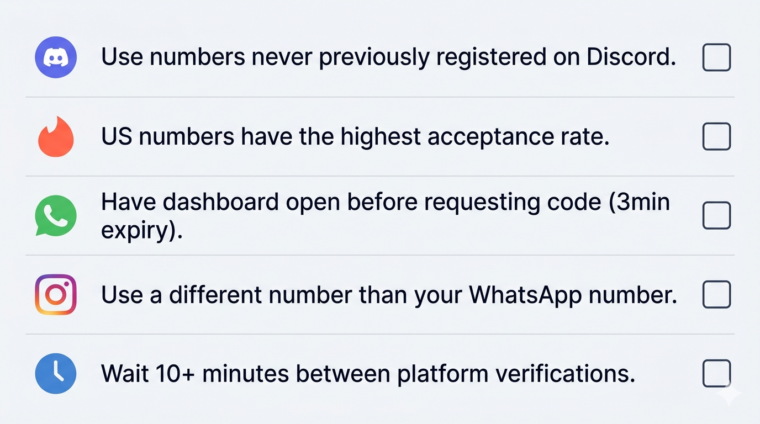
Alt text: „Platform-specific verification tips checklist for Discord, Tinder, WhatsApp, and Instagram“
Action Checklist
Before your next multi-platform verification session, confirm these items:
Carrier-grade virtual number platform selected (not VoIP, not shared numbers)
One unique number is provisioned for each platform and each account
Country codes matched to each platform’s primary market (US/UK for highest acceptance)
Verification dashboard open in browser before requesting any codes
Accounts verified one at a time with 10+ minute gaps between platforms
Rental numbers assigned to accounts you plan to keep active long-term
Temporary numbers assigned to one-off signups and throwaway research accounts
Spreadsheet or document mapping each number to each account for future reference
Conclusion
The multi-account verification problem is a logistics problem, not a technology problem. The tools exist. Carrier-grade virtual numbers pass Discord verification, Tinder verification, WhatsApp verification, and virtually every other platform that requires SMS-based identity confirmation.
What separates creators who get locked out from those who operate smoothly is operational discipline: separate numbers per platform, country code matching, timing between verifications, and tracking which number maps to which account. Treat phone numbers as disposable infrastructure, not personal identity, and the verification wall stops being a barrier.