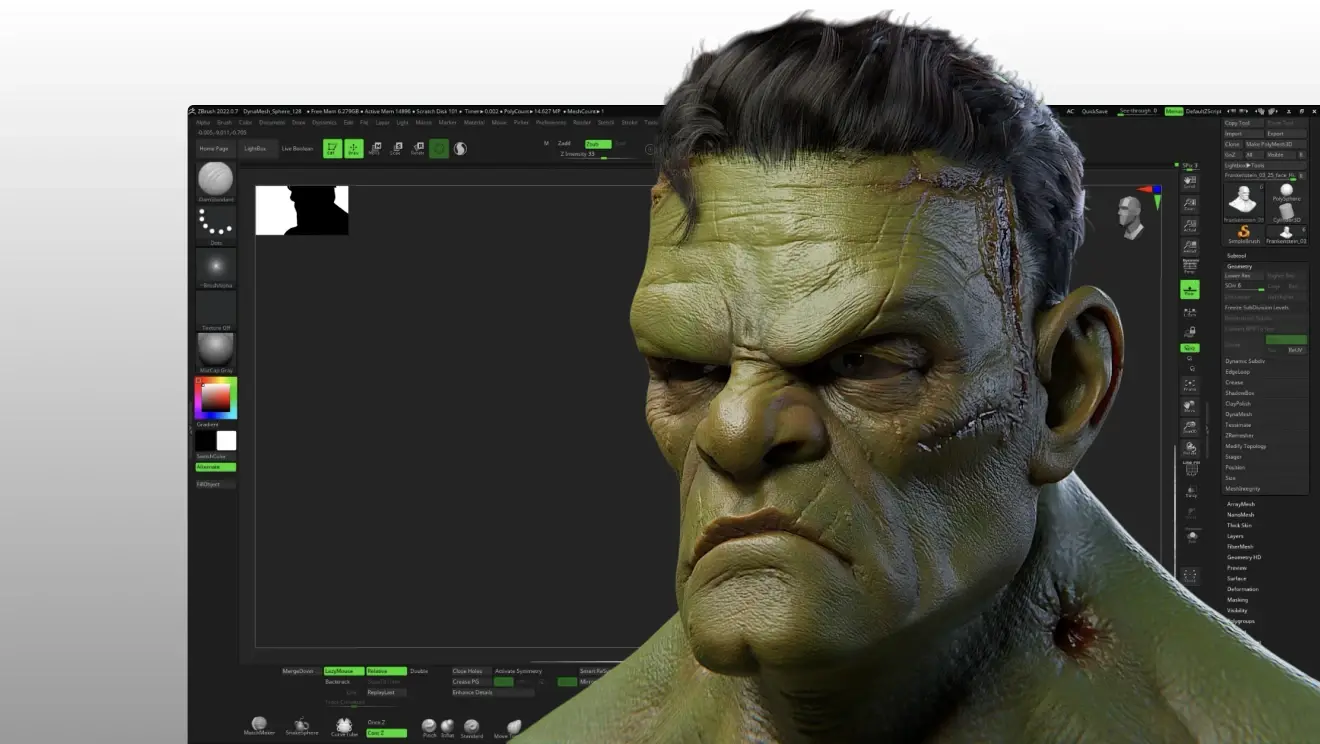
Creating 3D assets has traditionally required a mix of technical skill, specialized software, and long production cycles. This is exactly where AI is beginning to change the landscape. Tools powered by artificial intelligence are redefining how digital assets are produced, allowing creators to move from concept to finished model much faster. Among the new generation of tools, Tripo stands out as an advanced AI 3D model generator designed to simplify the entire workflow.
Instead of spending hours manually sculpting objects or characters, creators can generate high-quality models from simple prompts or reference images. With Tripo, the focus shifts from technical complexity to creative exploration.
Why AI 3D Model Generators Are Transforming Digital Creation
The demand for 3D assets has never been higher. Game development, AR/VR experiences, product visualization, 3D printing, and virtual worlds all rely on large volumes of 3D content. However, traditional modeling pipelines remain slow and resource-intensive. Artists need to handle multiple steps, including geometry modeling, topology cleanup, UV mapping, texturing, rigging and animation preparation.
For many creators, mastering all these stages requires years of experience. This is why the emergence of the AI 3D model generator is such a major shift. By automating parts of the workflow, these tools reduce production time while still maintaining high visual quality.
Tripo Studio is built around this philosophy. As an AI 3D model generator, it focuses on generating usable assets quickly while keeping them suitable for real production pipelines.
Flexible Model Generation
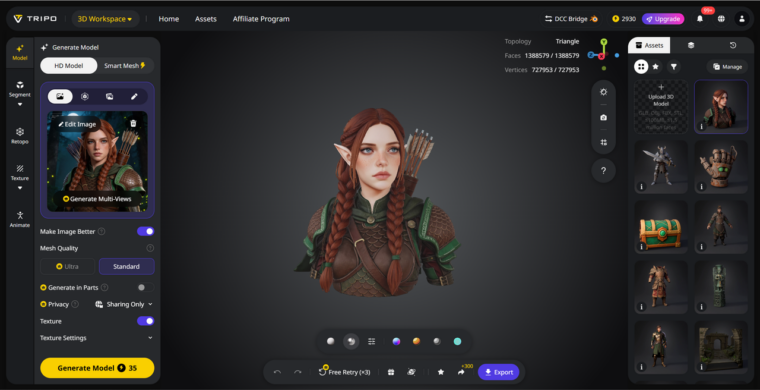
One of the most powerful capabilities of Tripo is its ability to generate models from both text prompts and images.
With the text to 3D model feature, users simply describe the object they want. The AI interprets the prompt and generates a complete 3D model in minutes. This allows creators to experiment with ideas quickly and iterate without starting from scratch every time.
For creators who already have reference artwork, the image to 3D model feature provides another efficient workflow. By uploading an image, the AI analyzes shapes, depth, and structure to reconstruct a 3D model. Multi-view images can further improve accuracy and produce more detailed results.
This flexibility makes the AI 3D model generator useful across many creative scenarios—from concept art visualization to rapid prototyping.
Other Refinement Tools
Generating a model is only the first step. For assets to be truly usable in production, they must be properly structured, textured, and prepared for animation.
Tripo integrates several intelligent tools that extend the capabilities of its AI 3D model generator, allowing creators to move from generation to production more efficiently.
Segmentation
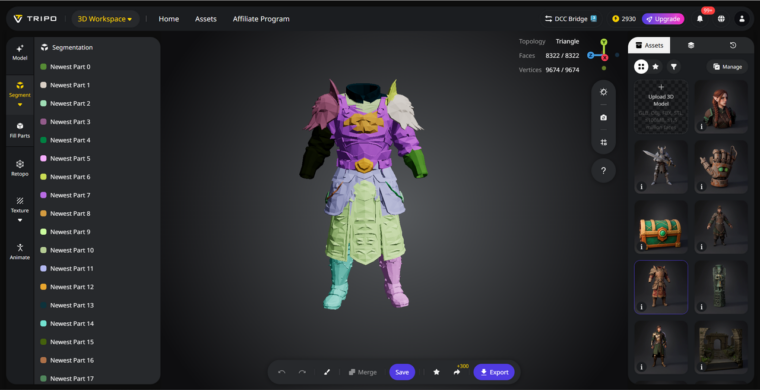
Complex models often contain multiple parts that need to be edited separately. Tripo’s smart segmentation automatically divides a model into logical components. This makes it easier to modify specific sections of the model without affecting the entire mesh. Segmentation is particularly useful when adjusting textures, editing geometry, or preparing assets for animation. By automatically identifying model components, Tripo reduces the need for manual mesh editing.
Retopology
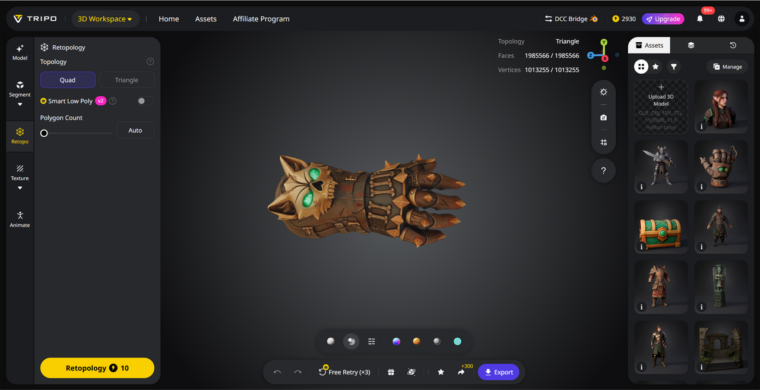
Topology plays a critical role in real-time rendering and animation pipelines. Clean topology ensures models deform correctly and remain optimized for engines and interactive environments. Tripo includes smart retopology tools that generate structured low-poly meshes suitable for production use. Users can choose polygon limits or remeshing styles depending on the needs of their pipeline. This feature allows the AI 3D model generator to produce models that are not only visually detailed but also technically usable.
AI Texturing
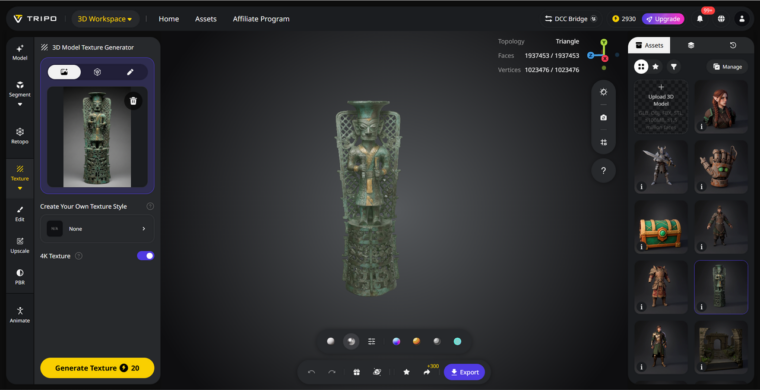
Surface appearance is just as important as geometry. Materials, colors, and surface details determine how realistic or stylized a model appears. The AI texturing system automatically generates high-quality textures based on the geometry and context of the model. It can also generate textures from prompts or reference images. Recent improvements have introduced Ultra HD texture generation, providing sharper details, clearer materials, and a more realistic surface appearance. With AI-driven texturing integrated into the pipeline, it can produce visually complete assets without manual texture painting.
Auto Rigging
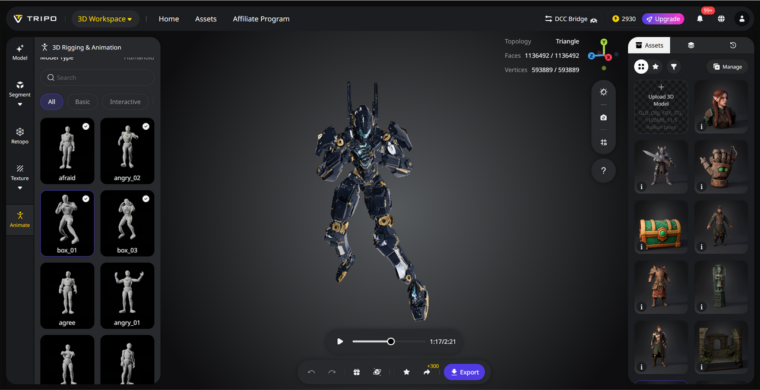
Preparing models for animation is often one of the most technically demanding steps in 3D production. Tripo simplifies this process with automatic rigging, which generates skeleton structures for character models in a single step. This allows creators to animate models quickly without manually placing bones or weight painting. The platform also includes a motion library with more than 100 mocap-quality animations, making it easy to test movement or prototype character behavior. By integrating rigging and animation preparation into the platform, the AI 3D model generator extends beyond modeling and supports a wider range of creative workflows.
Seamless Integration with DCC Tools
Although AI can generate assets quickly, many creators still rely on traditional Digital Content Creation (DCC) tools for further refinement and integration into production pipelines. Tripo supports workflows that connect directly with industry-standard software. With DCC bridges, assets generated by Tripo can be exported and edited in tools such as:
- Blender
- Unity
- Unreal Engine
- 3ds Max
This compatibility allows creators to combine the speed of AI generation with the precision of professional editing tools. For example, a model generated in Tripo can be refined in Blender, optimized for Unity, or integrated into Unreal Engine environments. This hybrid workflow ensures that the AI 3D model generator fits naturally into modern 3D pipelines rather than replacing them entirely.
Continuous Innovation: HD Model and Smart Mesh
AI-powered 3D creation is evolving rapidly, and Tripo continues to introduce new features that improve both quality and usability.
One of the most significant developments is the introduction of HD model generation, which produces higher-resolution geometry and more detailed textures. This allows the platform to create assets with greater fidelity and sharper visual details.
Another major improvement is Smart Mesh technology, which focuses on generating cleaner, more structured meshes that are easier to use in production environments. Smart Mesh improves topology organization and reduces unnecessary geometry, making models more suitable for game engines and real-time applications.
These innovations reflect Tripo’s goal of transforming the 3D AI generator from a simple concept tool into a production-ready asset pipeline.
A Growing Ecosystem of Creators
Beyond its technology, Tripo is also building a growing global community of creators. Designers, game developers, hobbyists, and digital artists are using Tripo Studio to explore new creative possibilities.
The platform’s gallery allows users to share their models, discover assets created by others, and remix existing work. This collaborative ecosystem helps creators learn new techniques and experiment with AI-assisted workflows. As more users adopt AI-driven tools, platforms like Tripo are becoming central hubs for next-generation 3D creation.
Conclusion
The rise of the AI 3D model generator represents a major shift in how digital assets are created. Instead of requiring deep technical expertise at every stage, creators can now rely on AI to automate many of the most time-consuming tasks.
Tripo demonstrates how modeling, segmentation, retopology, texturing, and rigging can be integrated into a unified platform. By reducing technical barriers and accelerating production workflows, it allows creators to focus on creativity and storytelling. As AI continues to evolve, tools like Tripo are likely to become an essential part of the future 3D production pipeline.